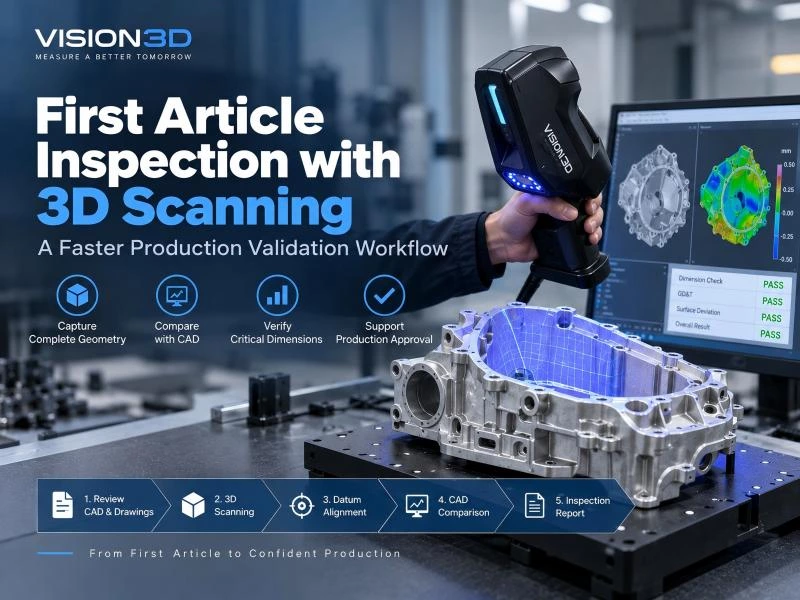
Automotive 3D Inspection Systems for EV Manufacturing: From BIW to Final Assembly
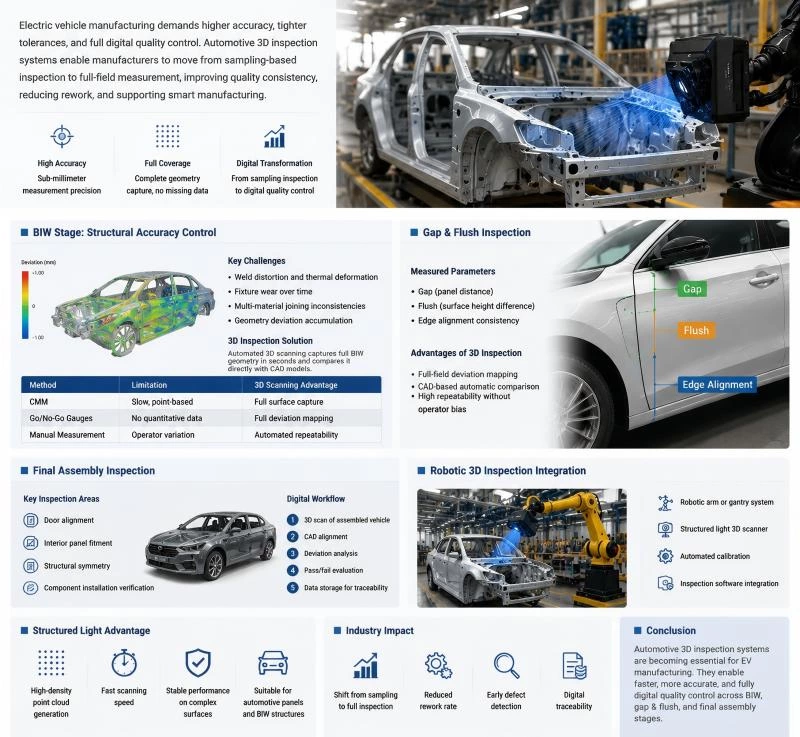
Why EV Manufacturing Requires High-Precision 3D Inspection Systems
Electric vehicle manufacturing has entered a stage of high-precision, data-driven production, where traditional manual inspection methods are no longer sufficient to guarantee dimensional consistency across large-scale Body-in-White (BIW) assemblies. Based on industry engineering practice, even sub-millimeter deviations in early structural stages can accumulate into significant alignment issues during final vehicle assembly.
From a manufacturing engineering perspective, 3D inspection systems are not simply measurement tools but a critical part of closed-loop quality control. They enable OEMs and Tier-1 suppliers to transition from reactive quality inspection to proactive process control, improving repeatability, traceability, and production stability across the entire EV assembly workflow.
In modern automotive metrology environments, structured light and laser-based 3D scanning technologies are widely adopted because they provide full-field measurement data that aligns directly with CAD engineering models. This ensures that dimensional validation is not based on sampling assumptions, but on complete geometry verification under real production conditions.
BIW Inspection: Structural Quality Foundation in EV Manufacturing
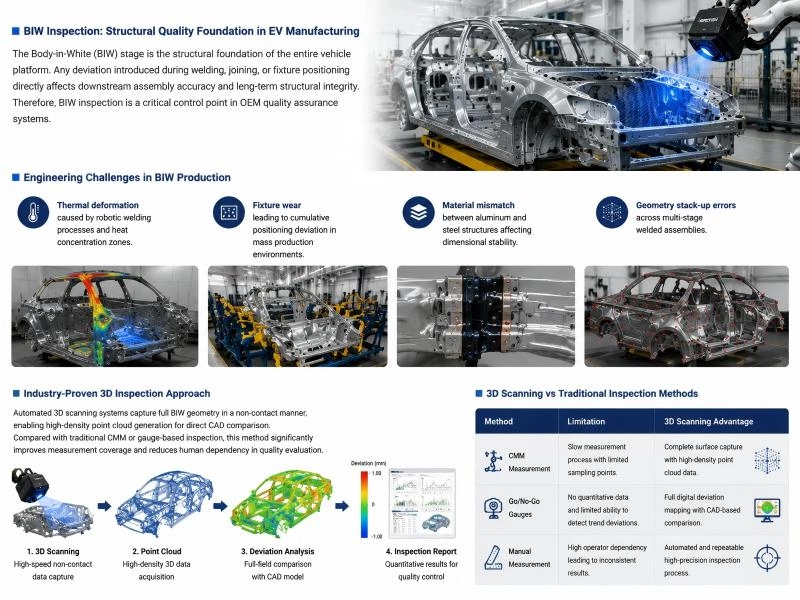
Based on automotive manufacturing standards, the Body-in-White stage represents the structural foundation of the entire vehicle platform. Any deviation introduced during welding, joining, or fixture positioning at this stage directly affects downstream assembly accuracy and long-term structural integrity. For this reason, BIW inspection is considered a critical control point in OEM quality assurance systems.
Engineering Challenges in BIW Production
- Thermal deformation caused by robotic welding processes and heat concentration zones
- Fixture wear leading to cumulative positioning deviation in mass production environments
- Material mismatch between aluminum and steel structures affecting dimensional stability
- Geometry stack-up errors across multi-stage welded assemblies
Industry-Proven 3D Inspection Approach
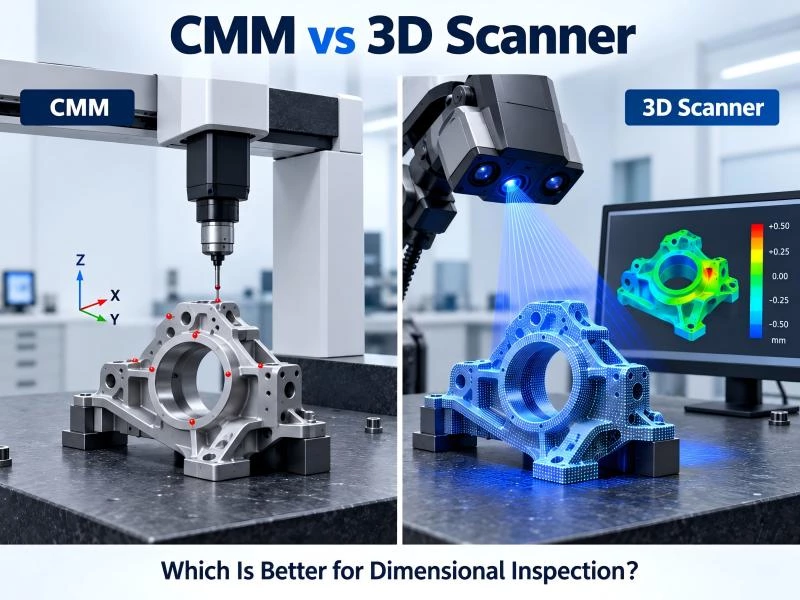
In industrial applications, automated 3D scanning systems are used to capture full BIW geometry in a non-contact manner, enabling high-density point cloud generation for direct CAD comparison. Compared with traditional CMM or gauge-based inspection, this method significantly improves measurement coverage and reduces human dependency in quality evaluation.
| Inspection Method | Engineering Limitation | 3D Inspection Value |
|---|---|---|
| CMM Measurement | Point-based sampling cannot represent full-surface deformation in complex structures | Full-field geometry capture with high-density measurement data |
| Manual Gauging | Operator-dependent results with limited quantitative analysis capability | Automated deviation analysis based on CAD reference models |
| Go/No-Go Fixtures | Lack of digital traceability and statistical process control capability | Digital measurement enabling SPC integration and trend analysis |
Gap & Flush Inspection: OEM Exterior Quality Standard
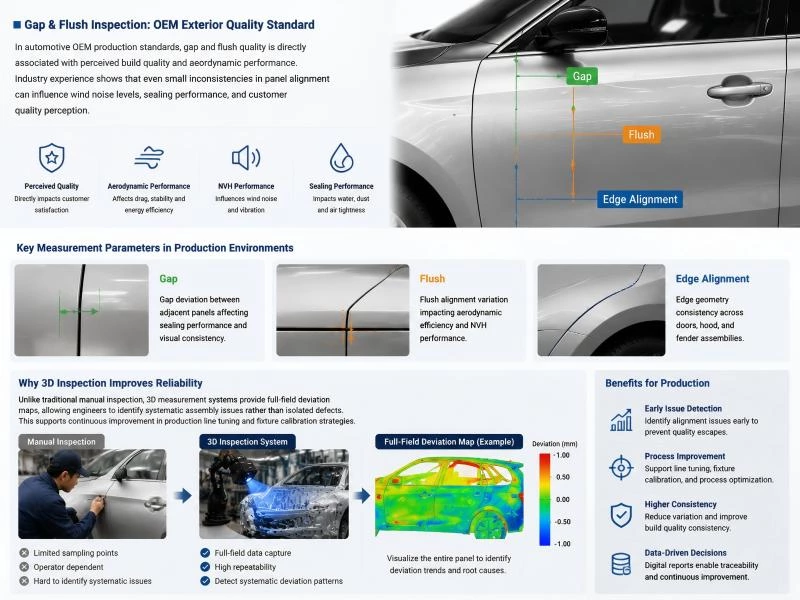
In automotive OEM production standards, gap and flush quality is directly associated with perceived build quality and aerodynamic performance. Industry experience shows that even small inconsistencies in panel alignment can influence wind noise levels, sealing performance, and customer quality perception.
Key Measurement Parameters in Production Environments
- Gap deviation between adjacent panels affecting sealing and visual consistency
- Flush alignment variation impacting aerodynamic efficiency and NVH performance
- Edge geometry consistency across doors, hood, and fender assemblies
Why 3D Inspection Improves Reliability
Unlike traditional manual inspection, 3D measurement systems provide full-field deviation maps, allowing engineers to identify systematic assembly issues rather than isolated defects. This supports continuous improvement in production line tuning and fixture calibration strategies.
Final Assembly Verification: Production Release Control Point
Final assembly inspection represents the last quality gate before vehicle release. In OEM manufacturing systems, this stage is used to verify whether all structural, interior, and exterior components meet engineering specifications under real assembly conditions.
From a process control perspective, final inspection is not only defect detection but also a validation of production system stability, ensuring that accumulated tolerances remain within acceptable engineering limits.
Critical Inspection Zones
- Door fitment accuracy and sealing line consistency
- Interior panel alignment and structural symmetry
- Full-body geometric deformation detection
- Assembly completeness and component positioning verification
Robotic 3D Inspection Integration in Smart Manufacturing
In advanced EV production facilities, robotic 3D inspection systems are widely implemented as part of smart factory automation strategies. These systems integrate robotic positioning with structured light scanning to achieve repeatable, high-speed inspection cycles suitable for high-volume production environments.
- Robotic motion systems ensuring repeatable scanning trajectories
- High-resolution structured light or laser scanning modules
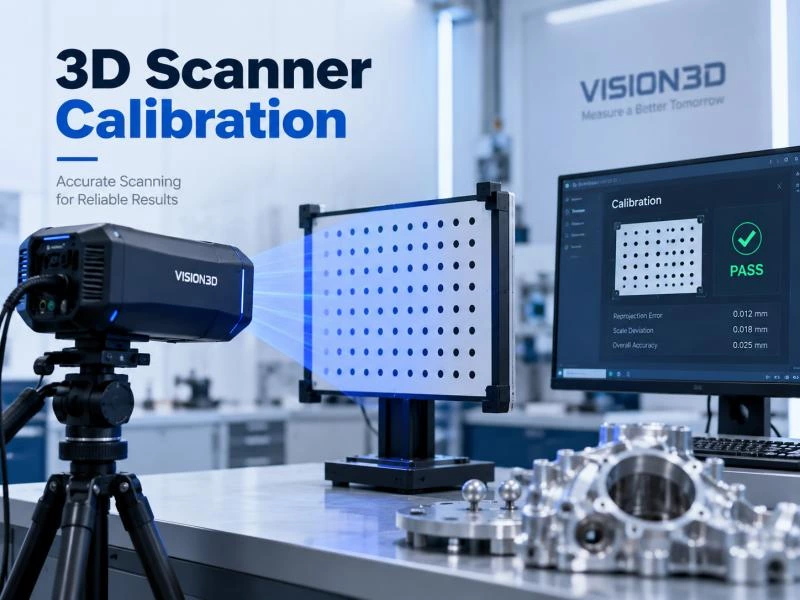
- Automated calibration and environmental compensation algorithms
- Integration with MES and quality management systems
Industry Impact: Transition Toward Digital Manufacturing Quality Control
Industry data and manufacturing case studies consistently show that adoption of 3D inspection systems enables a structural shift in quality control methodology, moving from sample-based inspection toward full-process digital verification. This transition significantly reduces rework rates, improves first-pass yield, and enhances overall production efficiency in EV manufacturing environments.
- Reduction of assembly rework and correction cycles
- Improved defect detection at early production stages
- Enhanced traceability for regulatory and OEM compliance
- Standardization of digital quality documentation
Conclusion: Role of 3D Inspection in Future EV Manufacturing
Automotive 3D inspection systems are becoming an essential component of modern EV manufacturing infrastructure. By enabling high-precision, full-field measurement and CAD-based analysis, they support the transition toward intelligent, data-driven production systems. In the long term, these technologies will play a central role in achieving stable quality control, reduced manufacturing variability, and improved lifecycle reliability across global automotive supply chains.