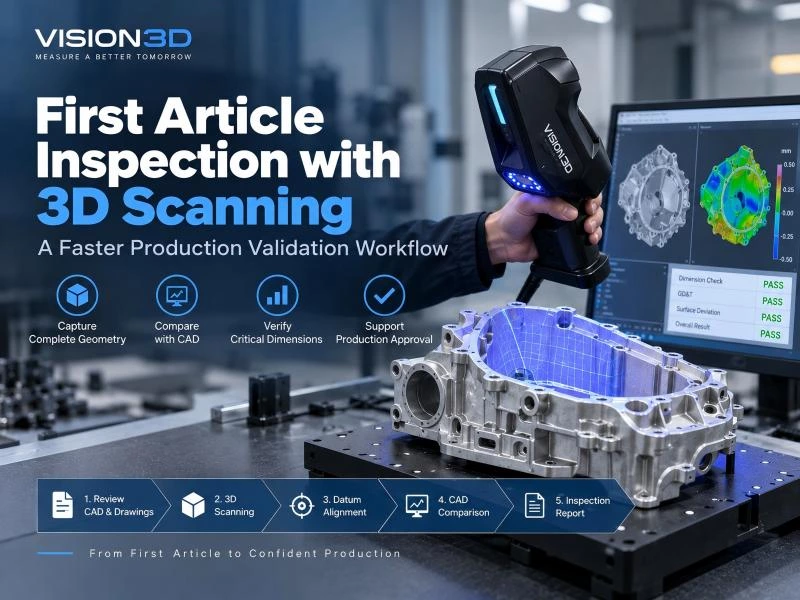
Replace Custom Gauges with 3D Scanning: A Faster Way to Reduce Inspection Costs by Up to 30%
In automotive manufacturing, dimensional inspection has traditionally relied on physical gauges, checking fixtures, and CMM-based measurement programs. These methods are widely used in stamping, casting, and welded assembly processes to ensure dimensional consistency across production batches.
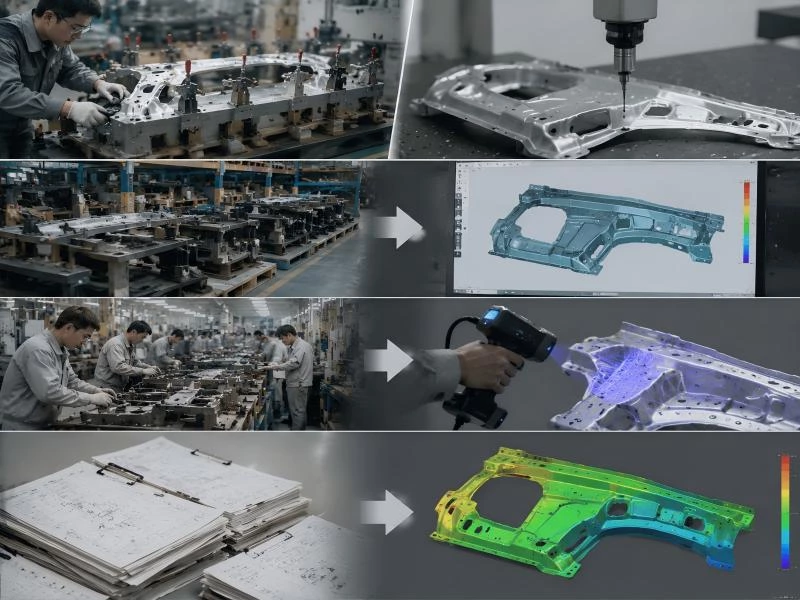
However, as product lifecycles continue to shorten and OEM platforms evolve faster, fixture-based inspection systems are becoming increasingly difficult to maintain. Each design revision typically requires new tooling, engineering validation, and additional lead time before production can resume stable inspection.
In practice, this leads to higher inspection overhead, slower quality feedback loops, and reduced responsiveness on the production floor.
Industrial 3D scanning introduces a different approach by shifting inspection from physical fixtures to digital measurement workflows based on full surface data capture.
The Real Cost of Traditional Gauges in Automotive Inspection
For suppliers producing body-in-white structures, chassis components, or functional structural parts, inspection fixtures are often underestimated in total cost of ownership. The expense is not only in fabrication, but also in maintenance and lifecycle management.
| Cost Factor | Impact |
|---|---|
| Fixture design & manufacturing | $3,000 – $8,000+ per set depending on geometry complexity and tolerance requirements |
| Development lead time | 6–8 weeks including design validation and manufacturing cycles |
| Engineering changes | Any CAD revision typically triggers partial or full fixture redesign |
| Storage & calibration | Requires controlled storage space and periodic verification |
| Lifecycle obsolescence | Fixtures are often retired when platforms or models are updated |
In multi-program automotive supply environments, these combined costs can accumulate to six-figure annual expenditure, especially where frequent model variation is involved.
Digital Replacement: Industrial 3D Scanning Technology
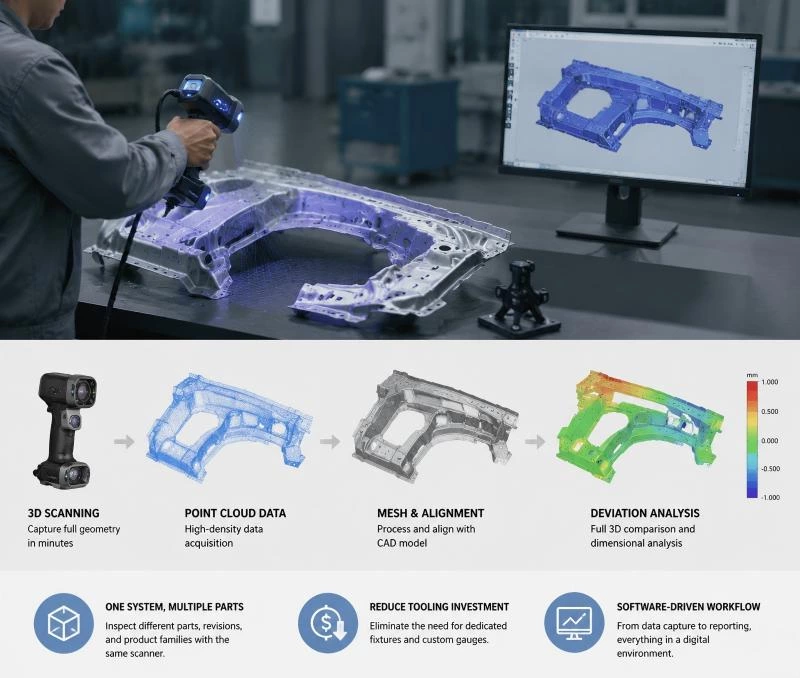
Instead of designing dedicated gauges for each part number, manufacturers are increasingly adopting industrial 3D measurement systems that capture complete geometry data directly from physical parts.
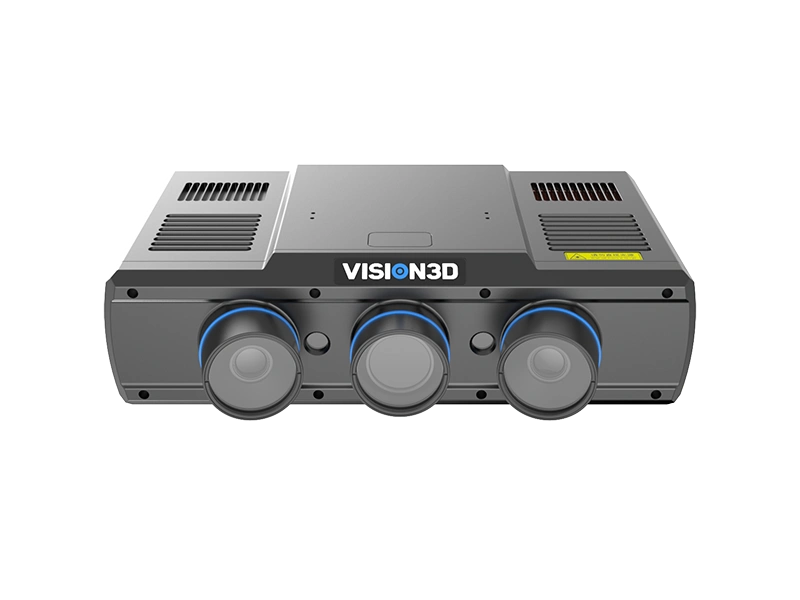
Vision3D handheld scanning systems, including the VScan M series and PowerScan structured light platforms, are designed to capture dense point cloud data in a single acquisition process, converting physical geometry into a digital model within minutes.
Unlike traditional inspection fixtures, these systems are not tied to a single part or product configuration. The same device can be used across different geometries, revisions, and product families without additional tooling investment.
This fundamentally changes the inspection workflow from hardware-dependent measurement to software-driven dimensional analysis.
Traditional Gauges vs 3D Scanning: Key Differences
| Inspection Aspect | Custom Gauges | Vision3D 3D Scanning Solution |
|---|---|---|
| Deployment time | Requires manufacturing and validation cycles | Available immediately after system setup |
| Flexibility | Fixed to a single part definition | Reusable across multiple part geometries |
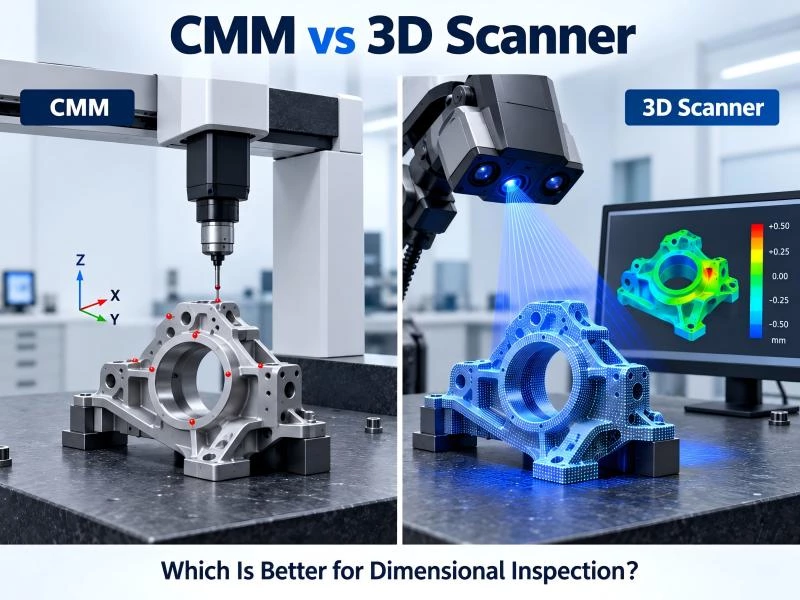
| Measurement method | Contact-based point measurement | Full-field non-contact surface capture |
| Output data | Pass/fail or limited dimension checks | Full 3D deviation and surface comparison |
| Cost structure | Recurring tooling and modification cost | Single system investment with reusable capability |
As a result, inspection strategy shifts from fixed verification tooling to a more flexible digital measurement approach based on CAD comparison.
From Sampling to Full 3D Inspection
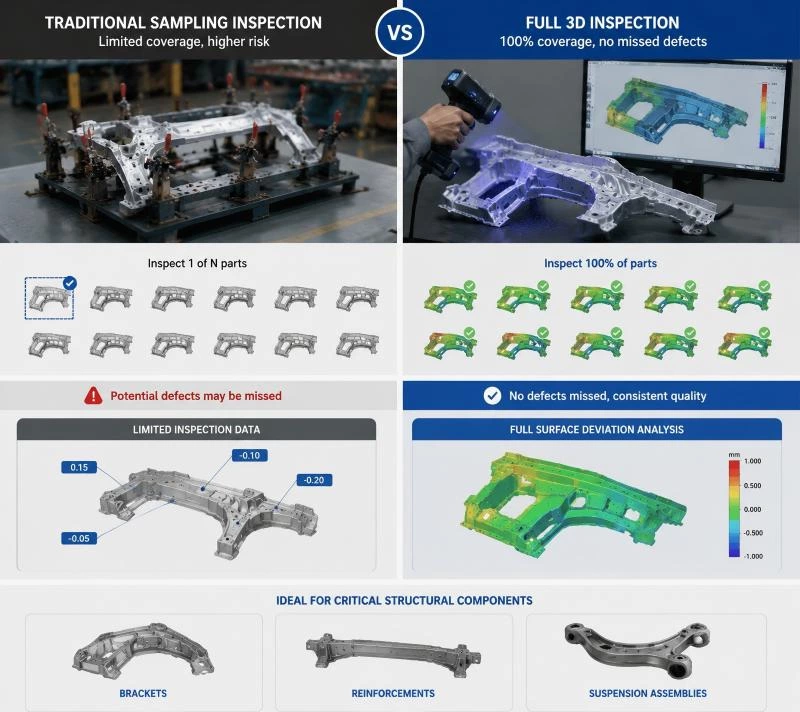
In traditional workflows, inspection fixtures are typically reserved for first-article verification or periodic sampling due to cost and handling complexity.
With 3D scanning systems, inspection cost per part is no longer constrained by physical tooling. Once the system is deployed, manufacturers can extend inspection coverage from sampling to full-part dimensional verification without additional fixture investment.
Each scanned dataset can be directly aligned with CAD geometry, enabling full-surface deviation analysis and clear visualization of tolerance distribution across complex geometries.
This approach is particularly relevant for structural components such as brackets, reinforcements, and suspension-related assemblies, where dimensional stability directly impacts long-term functional performance.
Application Example: Automotive Supplier Transformation
A tier-1 automotive supplier producing stamped body panels for multiple OEM platforms previously maintained more than 40 dedicated inspection fixtures across different product programs.
Total annual expenditure on fixture maintenance, updates, and new program tooling exceeded $180,000.
After introducing Vision3D industrial scanning systems, including both handheld and automated solutions, the inspection workflow was restructured:
- Eliminated most new fixture requirements for incoming programs
- Reduced inspection cycle time from approximately 45 minutes (CMM-based) to under 5 minutes per part
- Improved dimensional traceability through full digital inspection records
- Achieved over 30% reduction in total inspection-related operating cost
The system was integrated into existing CAD and PLM workflows, allowing engineering teams to adopt digital inspection without major process disruption.
Accuracy in Real Manufacturing Environments
When evaluating replacement of physical gauges, one of the primary concerns is whether optical scanning can meet production-level measurement requirements.
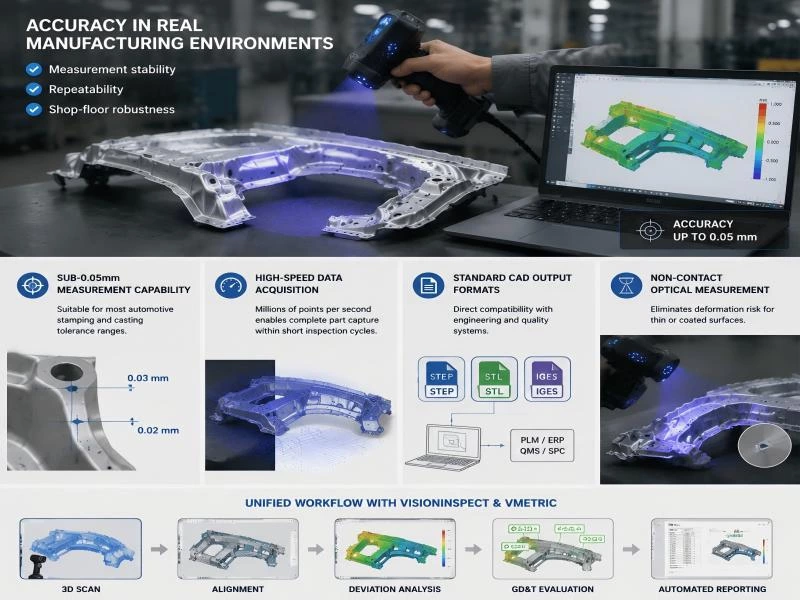
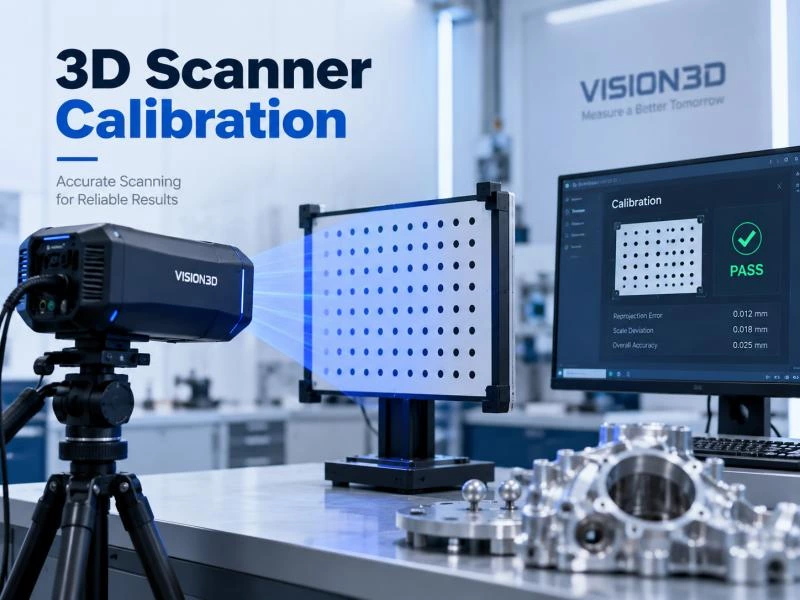
Vision3D systems are developed for industrial metrology environments where measurement stability, repeatability, and robustness under shop-floor conditions are critical.
| System Capability | Industrial Value |
|---|---|
| Sub-0.05mm measurement capability | Suitable for most automotive stamping and casting tolerance ranges |
| High-speed data acquisition (millions of points per second) | Enables complete part capture within short inspection cycles |
| Standard CAD output formats (STEP, STL, IGES) | Direct compatibility with engineering and quality systems |
| Non-contact optical measurement | Eliminates deformation risk for thin or coated surfaces |
Combined with VisionInspect software and VMetric analysis tools, users can perform deviation analysis, GD&T evaluation, and automated reporting within a unified workflow.
How to Transition to a Digital Inspection Workflow
Adoption of 3D scanning-based inspection systems typically follows a structured implementation process:
- Assessment – Identify current inspection bottlenecks using representative production parts.
- Validation – Compare scanned data against existing CMM or fixture-based results for accuracy verification.
- Deployment – Integrate scanning systems such as VScan M or PowerScan into production inspection environments.
Conclusion: Moving Beyond Physical Gauges
Physical inspection gauges were designed for manufacturing environments where product iterations were relatively stable and changes were infrequent. Modern automotive production requires faster adaptation, higher flexibility, and full digital traceability across the lifecycle.
Industrial 3D scanning enables this transition by replacing dedicated fixtures with scalable digital measurement systems.
By adopting Vision3D inspection solutions, manufacturers can reduce tooling dependency, improve inspection responsiveness, and optimize overall quality control efficiency.
To evaluate implementation in your production environment, an on-site demonstration can be arranged with application engineers.