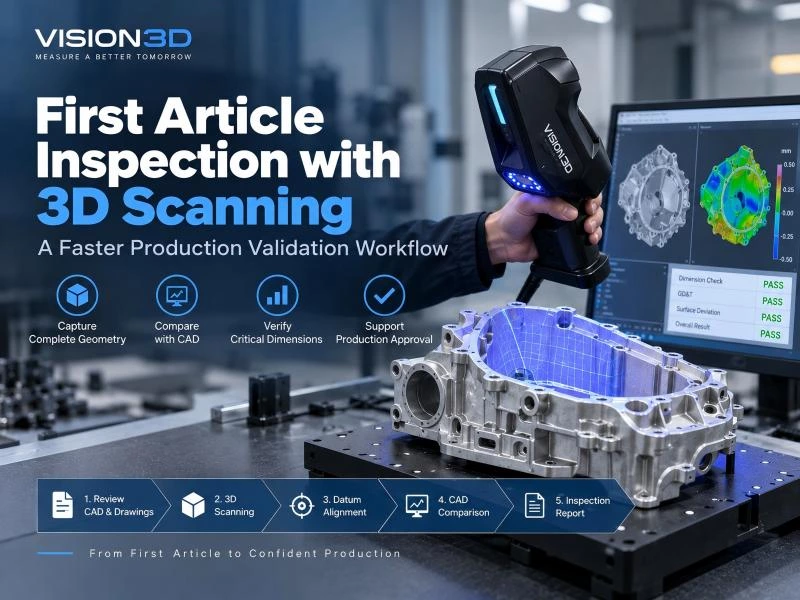
AutoScan Automated 3D Measurement System for Industrial Quality Inspection
What Is the AutoScan Automated Measurement System?
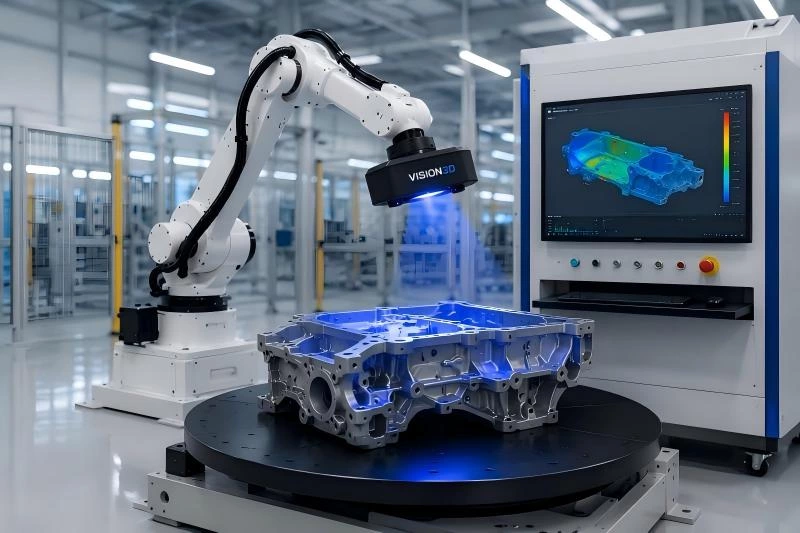
AutoScan is an automated 3D measurement system designed for manufacturers that need faster, more stable, and more repeatable dimensional inspection. Instead of relying only on manual gauges, contact measurement, or isolated sampling, AutoScan combines robotic motion, blue-light 3D scanning, inspection software, and automated data processing into one complete measurement workflow.
The system is developed for industrial quality control scenarios where part geometry is complex, inspection volume is high, and measurement consistency must be maintained across different operators, shifts, and production batches.
For manufacturers building automated inspection capability, the AutoScan Series automated 3D inspection systems provide scalable solutions from compact workstations to full-vehicle and large structural measurement platforms.
In practical production, AutoScan is not only a measuring device. It is a digital inspection platform that helps quality teams capture complete 3D data, compare actual parts with CAD models, analyze deviation, generate inspection reports, and support process improvement decisions.
Why Manufacturers Need Automated 3D Inspection
Many factories still use manual inspection tools, checking fixtures, or traditional CMM systems for dimensional verification. These methods can be effective for certain parts, but they become inefficient when manufacturers need to inspect complex surfaces, large structures, welded assemblies, or high-volume production batches.
The real challenge is not only measurement accuracy. The bigger challenge is whether the inspection process can remain fast, repeatable, traceable, and useful for production decisions.
| Inspection Challenge | Traditional Limitation | AutoScan Value |
|---|---|---|
| Complex surface geometry | Point-based inspection cannot show full deformation | Full-field 3D data captures complete surface deviation |
| High inspection workload | Manual operation increases cycle time | Robotic scanning improves inspection efficiency |
| Operator variation | Different users may produce inconsistent results | Automated paths and software workflows improve repeatability |
| Large component inspection | Manual setup and repositioning are time-consuming | Modular robotic layouts support larger measurement ranges |
| Quality traceability | Reports are often separated from production data | Digital inspection results support long-term process tracking |
For automotive, aerospace, electronics, and precision manufacturing, automated 3D inspection helps move quality control from delayed verification to real-time production feedback.
How AutoScan Works in an Automated Inspection Workflow
Although different production lines use different automation layouts, most AutoScan systems follow the same measurement logic. Instead of separating scanning, analysis, and reporting into independent operations, the entire inspection process is connected through one digital workflow. This minimizes manual intervention while ensuring that every inspected part follows the same measurement procedure.
Compared with conventional inspection methods, the automated workflow not only improves efficiency but also reduces operator-dependent variation and makes inspection results easier to trace throughout the manufacturing process.
1. Automated Part Positioning
Inspection begins with positioning the workpiece. Depending on component size and production requirements, parts can be loaded onto rotary tables, dedicated fixtures, conveyor stations, or customized workstations. Large structural components may be measured using robot tracks or multi-station configurations.
Stable positioning is critical because every subsequent measurement depends on the repeatability of the initial setup. Automated positioning also reduces the influence of manual loading errors on final inspection results.
2. Intelligent Robotic Scanning
Once positioning is completed, the robot automatically follows the predefined scanning path. Multiple viewing angles are combined to capture complex surfaces that are difficult to inspect using traditional contact measurement.
- Freeform surfaces
- Deep pockets and recessed features
- Hole locations
- Trim edges
- Assembly interfaces
Because every scanning path is automatically repeated, inspection quality remains consistent regardless of production shift or operator.
3. Automatic Data Registration
After scanning, all captured point cloud data is merged into a complete digital model. AutoScan supports intelligent alignment algorithms that significantly reduce manual preprocessing before measurement.
For many industrial applications, markerless alignment eliminates the need for attaching physical reference targets, reducing preparation time while simplifying fixture design for automated production.
4. CAD-Based Quality Inspection
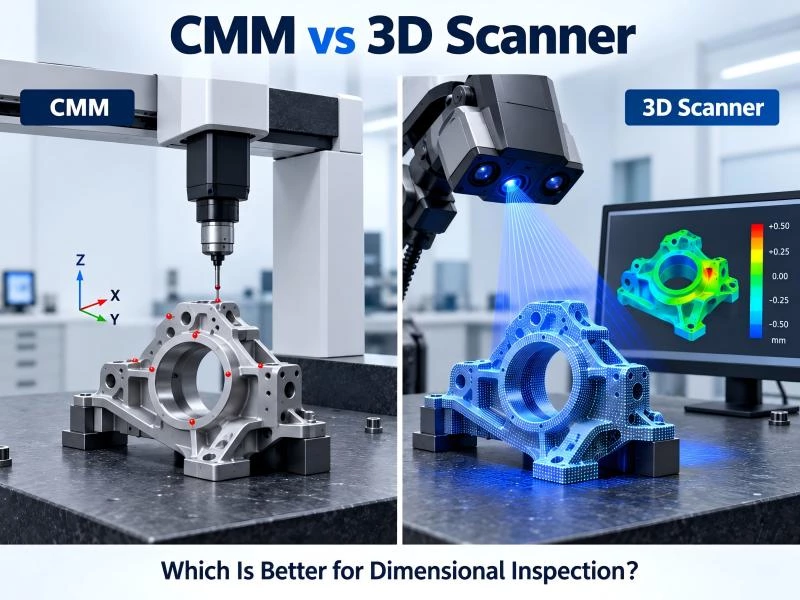
Instead of checking only several predefined dimensions, the software compares the complete scanned model with the original CAD design. Engineers can immediately visualize dimensional deviation across the entire component using color maps and numerical measurements.
| Inspection Item | Typical Analysis |
|---|---|
| Surface Profile | Overall deformation distribution |
| Hole Position | True position verification |
| Edge Geometry | Trim accuracy inspection |
| Assembly Surface | Flatness and matching accuracy |
| Critical Dimensions | GD&T verification |
5. Inspection Reporting and Process Feedback
Inspection does not end when measurement is completed. AutoScan automatically generates standardized reports containing deviation maps, dimensional results, statistical summaries, and pass/fail decisions.
These reports can be shared with production engineers, quality managers, suppliers, and customers, while historical inspection records help manufacturers identify process drift, tooling wear, and recurring quality issues before they affect downstream assembly.
Why Manufacturers Choose the AutoScan Series for Automated 3D Inspection
Selecting an automated 3D measurement system involves much more than comparing scanner specifications. Manufacturers must consider inspection repeatability, production efficiency, software capability, scalability, and the ability to integrate with existing manufacturing workflows.
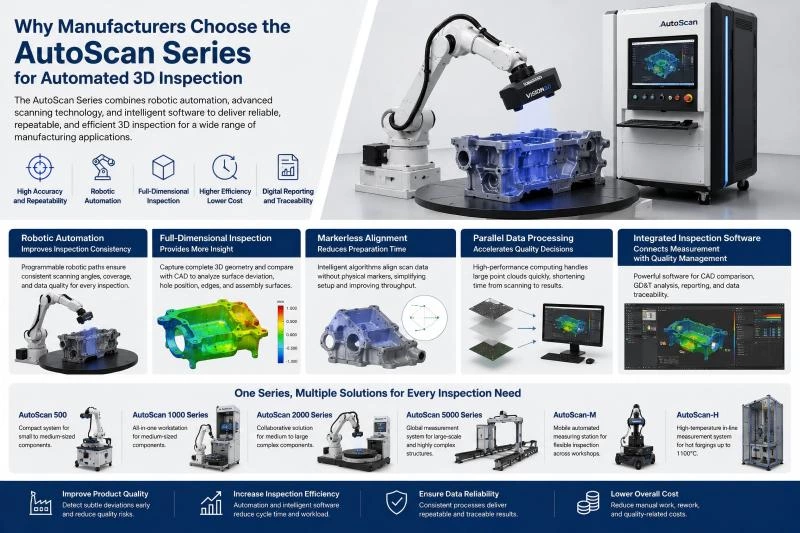
The AutoScan Series combines robotic automation, modular workstation design, intelligent measurement software, and high-speed data processing into a unified inspection platform. Rather than focusing on a single performance indicator, it is designed to improve the entire quality inspection workflow—from automated scanning to digital reporting.
The following technologies enable the AutoScan Series to support reliable, repeatable, and scalable automated inspection across a wide range of manufacturing applications.
AutoScan 500: Compact Automated 3D Measurement for Small and Medium Parts
Not every factory needs a large robotic inspection cell. For small and medium-sized components, manufacturers often need a compact system that can be deployed quickly, moved flexibly, and operated with limited floor space.
The AutoScan 500 compact automated 3D measurement system is designed for components up to 500 mm. It integrates a collaborative robot, electric rotary table, and mobile trolley to support multi-angle automated scanning and dimensional inspection.
Typical Applications
- Machined metal parts
- Small castings and forged parts
- Plastic injection molded components
- Precision brackets and housings
- Electronic and mechanical assemblies
For quality labs and shop-floor inspection areas, AutoScan 500 helps reduce repeated manual scanning work while keeping the inspection process stable and standardized.
AutoScan 1000: Turnkey Workstation for Medium-Sized Components
Medium-sized components often require a balance between automation, flexibility, and inspection efficiency. These parts may not justify a large customized cell, but manual inspection may still be too slow or inconsistent.
The AutoScan 1000 automated 3D measurement system is a turnkey digital inspection workstation designed for single-robot applications. It supports components up to 1000 mm and can be configured for in-line or off-line inspection scenarios.
| Inspection Need | Why AutoScan 1000 Fits |
|---|---|
| Medium part size | Supports automated inspection for parts up to 1000 mm |
| Complex geometry | Robotic scanning captures multiple angles and hard-to-measure surfaces |
| Production flexibility | Different workstation layouts support both in-line and off-line use |
| Inspection consistency | Automated scanning path reduces operator variation |
AutoScan 1000 is suitable for manufacturers that want to introduce automated metrology without building a highly customized large-scale inspection cell from the beginning.
AutoScan 2000: Collaborative Automated Measurement for Large Components
As component size increases, maintaining inspection accuracy becomes only one part of the challenge. Manufacturers must also consider scanning coverage, cycle time, robot accessibility, and the amount of data generated during each inspection cycle. Large welded structures, castings, battery trays, and body assemblies often require multiple scanning positions, making manual inspection both time-consuming and difficult to standardize.
The AutoScan 2000 collaborative automated 3D measurement system is designed specifically for medium to large components up to 2000 mm. It supports both single-robot and dual-robot configurations, allowing manufacturers to balance inspection speed with data completeness according to production requirements.
Why Collaborative Scanning Matters
Unlike conventional single-position measurement, collaborative robotic inspection divides the scanning task into multiple optimized paths. Robots work together to reduce unnecessary movement while ensuring that complex surfaces, hidden features, and assembly interfaces are fully captured.
- Higher inspection efficiency for large workpieces
- Reduced robot idle time
- Improved point cloud completeness
- Consistent inspection quality across production batches
- Suitable for automated production environments
This configuration is widely used for structural components where profile inspection, hole position verification, mounting surface analysis, and dimensional consistency directly influence downstream assembly quality.
AutoScan 5000: Global Measurement for Large Structural Assemblies
Some inspection tasks extend far beyond individual components. Automotive Body-in-White structures, battery pack frames, aerospace assemblies, and large fabricated structures require complete dimensional verification across several meters rather than localized measurements.
The AutoScan 5000 global automated measurement system is engineered for components up to 5000 mm and supports highly configurable robotic layouts, including linear tracks, rotary tables, and multiple workstation configurations.
Typical Applications
| Industry | Typical Components | Inspection Focus |
|---|---|---|
| Automotive | Body-in-White, battery trays, subframes | Global dimensional accuracy |
| Aerospace | Aircraft structural assemblies | Assembly alignment and profile accuracy |
| Rail Transit | Large welded structures | Assembly deviation and positioning |
| Heavy Equipment | Frames and fabricated structures | Hole position and surface measurement |
Rather than inspecting individual sections separately, AutoScan 5000 allows engineers to evaluate the dimensional relationship of the complete structure, making it easier to identify cumulative errors that may affect final assembly.
AutoScan-M: Flexible Automated Measurement Without Fixed Workstations
Not every inspection task takes place inside a dedicated measurement cell. Manufacturers often need to inspect components at different production stations, assembly lines, or temporary work areas where moving heavy parts into a laboratory is impractical.
The AutoScan-M mobile automated measuring station addresses this requirement by integrating a mobile manipulator with a high-precision blue-light 3D scanner. Instead of transporting the workpiece to the inspection system, the inspection system moves to the workpiece.
Advantages of Mobile Automated Measurement
- Suitable for distributed production environments
- Reduces transportation of large components
- Supports inspection at multiple production stations
- Improves equipment utilization across different projects
- Provides greater flexibility for smart factory deployment
AutoScan-H: Automated Inspection for High-Temperature Forgings
Conventional optical measurement systems are generally designed for room-temperature environments. However, forging manufacturers often need dimensional information while components remain at elevated temperatures, allowing production adjustments before cooling and secondary processing.
The AutoScan-H high-temperature in-line automated measurement system is specifically engineered for forging inspection at temperatures up to 1100°C. Through thermal protection, active cooling, intelligent filtering, and self-calibration technologies, the system performs reliable 3D measurement under harsh industrial conditions.
Industrial Benefits
- Detect dimensional deviation immediately after forging
- Reduce scrap caused by late-stage inspection
- Improve process stability through real-time feedback
- Support automated forging production lines
How to Choose the Right AutoScan System
Selecting an automated measurement system should be based on manufacturing requirements rather than scanner specifications alone. The optimal solution depends on the size of the workpiece, production rhythm, inspection objectives, and future automation plans.
| If Your Production Requires... | Recommended Solution |
|---|---|
| Small precision components under 500 mm | AutoScan 500 |
| Medium-sized automated inspection | AutoScan 1000 |
| Large structural components up to 2000 mm | AutoScan 2000 |
| Global inspection of assemblies up to 5000 mm | AutoScan 5000 |
| Flexible inspection across multiple stations | AutoScan-M |
| Inline inspection of hot forgings | AutoScan-H |
Manufacturers should also evaluate whether future production plans include higher throughput, robotic integration, MES connectivity, or expansion toward fully automated quality control. Choosing a scalable platform can reduce future upgrade costs and simplify system integration.
Typical Applications of the AutoScan Series
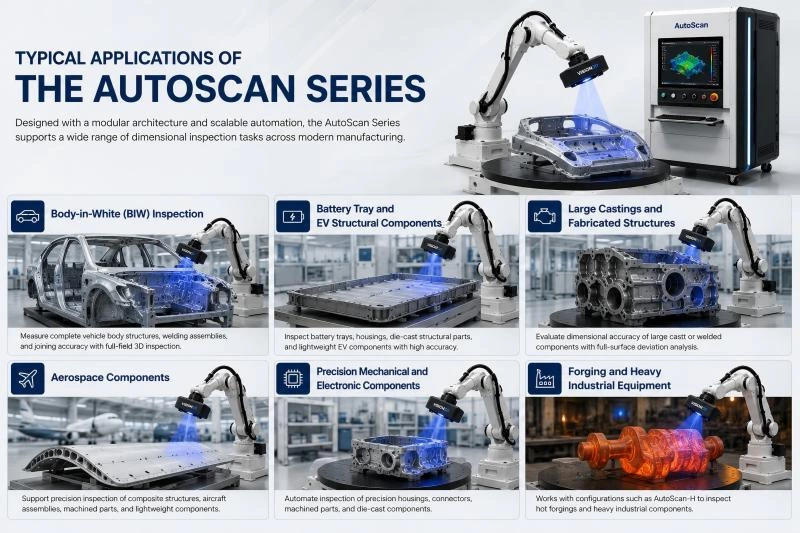
Designed with a modular architecture and scalable automation, the AutoScan Series supports a wide range of dimensional inspection tasks across modern manufacturing. Whether inspecting small precision components or large structural assemblies, the system can be configured to meet different production requirements while maintaining high accuracy and repeatability.
Body-in-White (BIW) Inspection
Measure complete vehicle body structures, welding assemblies, and joining accuracy with full-field 3D inspection. AutoScan helps manufacturers verify dimensional consistency before downstream assembly while reducing dependence on manual gauges and sampling inspection.
Battery Tray and EV Structural Components
Inspect battery trays, battery housings, die-cast structural parts, and lightweight EV components. Automated scanning enables accurate verification of assembly surfaces, hole positions, and critical dimensions for electric vehicle manufacturing.
Large Castings and Fabricated Structures
Evaluate dimensional accuracy of engine housings, transmission cases, subframes, machine bases, and other large cast or welded components. Full-surface deviation analysis provides more complete quality information than traditional point-based measurement.
Aerospace Components
Support dimensional inspection of composite structures, aircraft assemblies, machined parts, and lightweight components that require high repeatability and precise geometric verification.
Precision Mechanical and Electronic Components
Automate inspection of precision housings, connectors, machined parts, die-cast components, and other medium-sized workpieces where production efficiency and repeatable quality control are essential.
Forging and Heavy Industrial Equipment
Combined with dedicated configurations such as AutoScan-H, the system supports automated inspection of hot forgings, heavy equipment structures, and other large industrial components operating in demanding production environments.
Conclusion
As manufacturing shifts toward intelligent production, automated inspection is becoming a critical part of digital quality management rather than a standalone measurement activity.
The AutoScan Series combines robotic automation, high-precision 3D scanning, intelligent inspection software, and modular system architecture to help manufacturers improve measurement efficiency, inspection consistency, and production traceability across a wide range of industrial applications.
Explore the Complete AutoScan Product Family
Whether your inspection task involves compact precision parts, large structural assemblies, mobile measurement, or high-temperature forging inspection, the AutoScan Series provides scalable automated 3D measurement solutions for modern manufacturing.
Learn more about the AutoScan Automated Measurement System →
Frequently Asked Questions
What industries are AutoScan systems designed for?
AutoScan systems are widely used in automotive, aerospace, electronics, rail transit, heavy equipment, and other industries that require high-precision dimensional inspection and automated quality control.
Can AutoScan integrate with existing production lines?
Yes. Different AutoScan configurations support off-line inspection, near-line inspection, and in-line automated measurement. The modular architecture allows the system to adapt to various production layouts and automation levels.
What types of parts can be inspected?
Depending on the selected model, AutoScan can inspect components ranging from small precision parts under 500 mm to complete structural assemblies up to 5000 mm, as well as high-temperature forgings during production.
Does AutoScan support CAD comparison?
Yes. The system integrates inspection software capable of automatic CAD alignment, full-surface deviation analysis, GD&T evaluation, and standardized inspection reporting.
How do I choose the right AutoScan model?
Selection depends primarily on workpiece size, inspection cycle time, automation requirements, production environment, and future expansion plans. Compact workstations are suitable for smaller components, while collaborative and global measurement systems are designed for larger assemblies and higher production throughput.