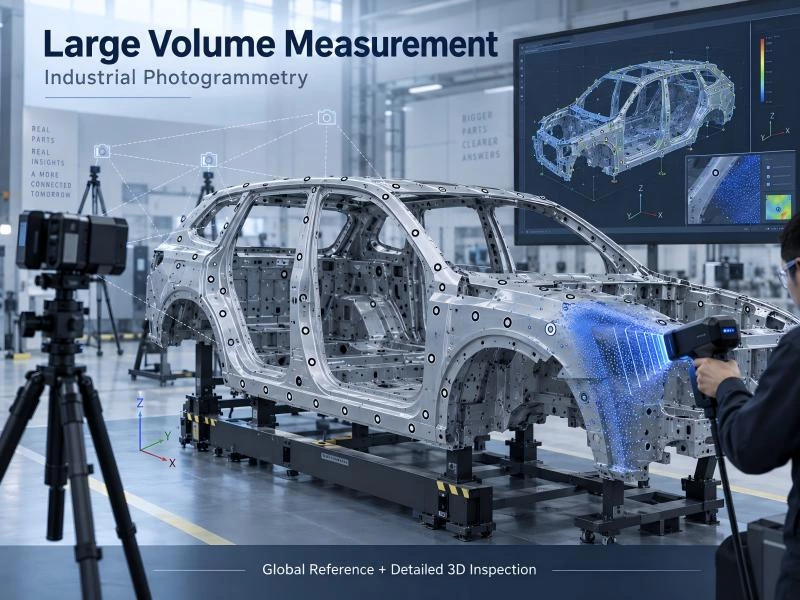
How Automated 3D Inspection Is Enabling the Next Generation of Flying Vehicle Manufacturing
As low-altitude aviation moves from prototype development toward commercial production, manufacturers face a challenge rarely seen in traditional industries: combining aerospace-level quality requirements with automotive-scale manufacturing efficiency.
Flying vehicles, eVTOL platforms, and advanced air mobility systems are introducing new expectations for precision, consistency, and traceability throughout the production process. Unlike conventional automobiles, these products integrate lightweight composite structures, complex aerodynamic surfaces, high-precision assembly interfaces, and stringent safety requirements. Every dimensional deviation can influence assembly accuracy, aerodynamic performance, structural integrity, and certification readiness.
For manufacturers pursuing large-scale production, traditional inspection methods are increasingly unable to provide the speed, coverage, and digital traceability required by modern quality systems. This is driving the adoption of automated 3D inspection technologies that can support both high-volume manufacturing and aviation-grade quality control.
Flying Vehicles Demand a Different Level of Quality Control
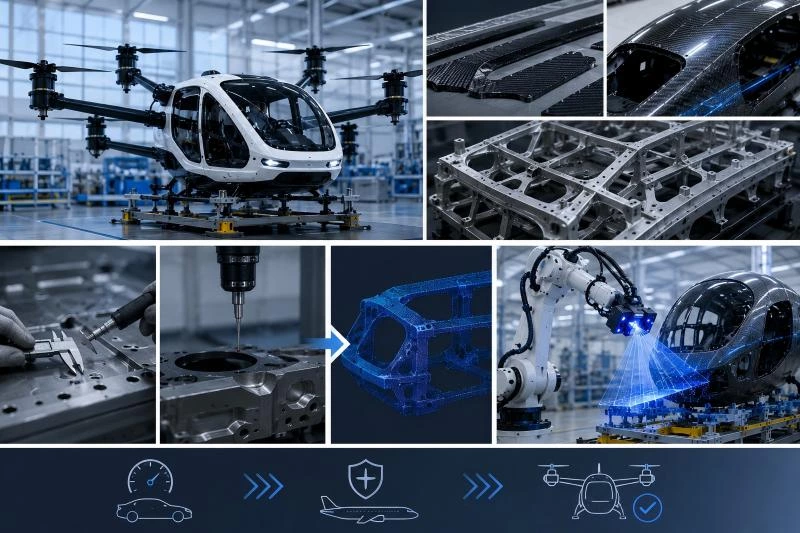
Manufacturing a flying vehicle is fundamentally different from building a conventional passenger car.
Automotive production typically focuses on assembly efficiency, dimensional consistency, and cost control. Aerospace manufacturing places greater emphasis on structural verification, safety validation, and long-term reliability. Flying vehicles combine both worlds, requiring manufacturers to achieve high throughput without compromising precision.
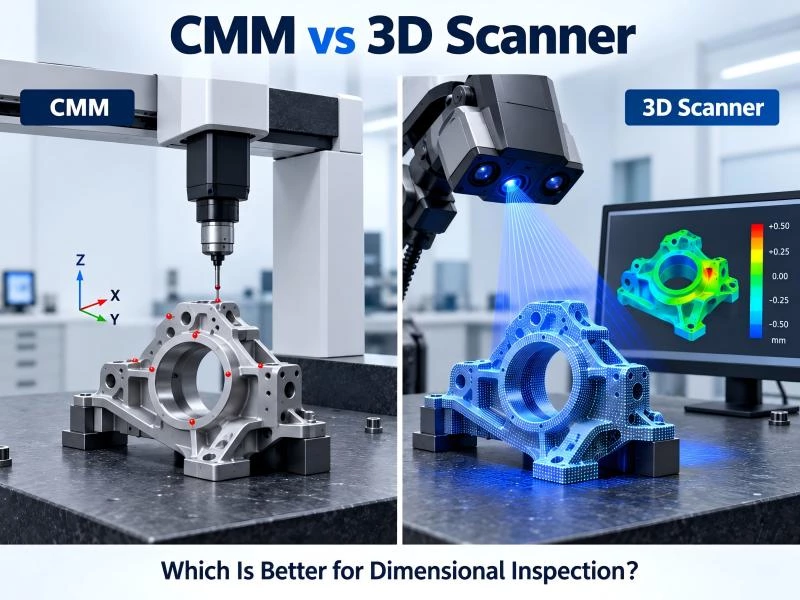
The challenge becomes even more significant when working with large composite structures. Carbon-fiber components, lightweight frames, aerodynamic body panels, and integrated assemblies often contain freeform surfaces that are difficult to inspect using traditional gauges or point-based measurement systems.
Many critical features cannot be evaluated effectively through sampling inspection alone. Manufacturers increasingly need complete digital representations of parts and assemblies to verify dimensions, monitor process variation, and ensure consistent production quality.
As production volumes increase, inspection systems must also deliver results quickly enough to avoid becoming a manufacturing bottleneck. This combination of precision and efficiency is one of the primary reasons advanced optical measurement technologies are gaining importance across emerging aviation programs.
Beyond Final Inspection: Building a Digital Manufacturing Baseline
Many quality systems still focus primarily on identifying defects after manufacturing is complete. While final inspection remains important, modern manufacturers are increasingly shifting toward prevention rather than detection.
Instead of simply determining whether a finished assembly passes inspection, manufacturers now seek to establish a digital baseline that can be used throughout the entire production process.
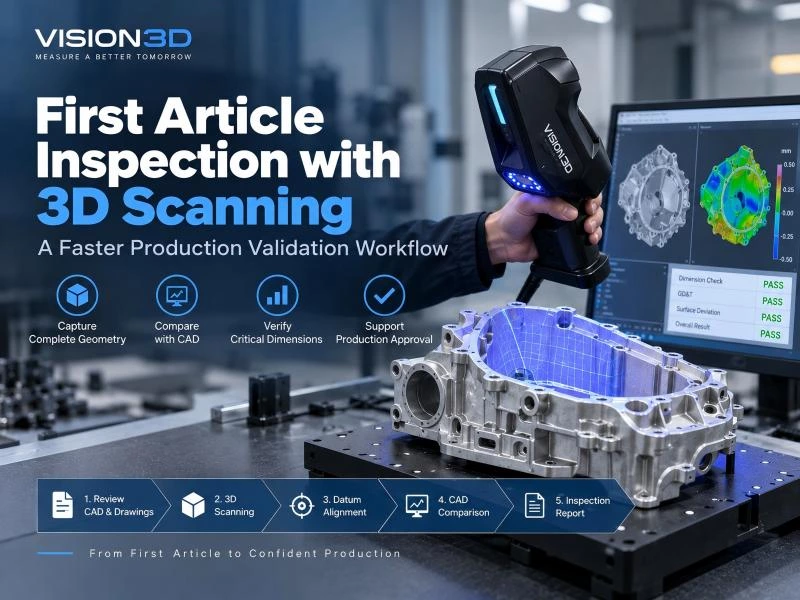
High-density 3D measurement data allows engineers to compare actual production results with CAD models, monitor assembly variation, and identify dimensional trends before defects propagate downstream. This approach transforms inspection from a quality gate into a process optimization tool.
When measurement data is captured consistently across multiple production stages, manufacturers gain a clearer understanding of how variation develops throughout manufacturing. Welding distortion, fixture positioning errors, assembly deviations, and tooling wear can all be identified earlier, reducing rework and improving overall process stability.
The result is a more predictable production environment where dimensional quality becomes measurable, traceable, and continuously controllable.
Blue-Light Automated Inspection for Complex Composite Structures
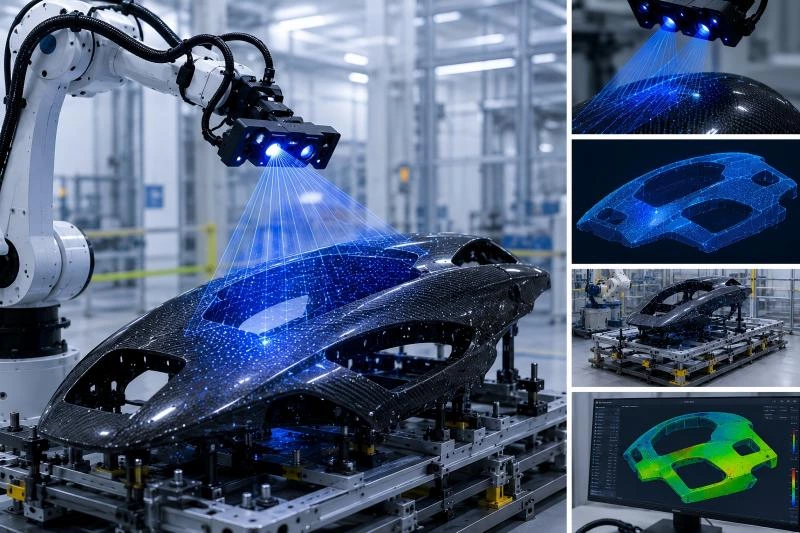
One of the most significant developments in industrial metrology has been the adoption of blue-light structured light scanning for automated inspection applications.
Compared with conventional measurement methods, blue-light scanning offers several advantages when inspecting large composite components and precision assemblies. The technology captures dense surface data rapidly while maintaining high accuracy across complex geometries.
For manufacturers working with carbon-fiber structures and reflective materials, non-contact measurement is particularly important. Blue-light systems can acquire detailed dimensional information without physically touching the part, reducing the risk of surface damage while maintaining measurement efficiency.
When integrated with robotic automation, inspection capability expands significantly. Automated scanning cells can inspect multiple surfaces from different orientations, reducing blind spots and improving measurement consistency across large assemblies.
Advanced robotic measurement systems also support continuous production workflows, allowing inspection to be performed with minimal operator intervention while maintaining repeatable results.
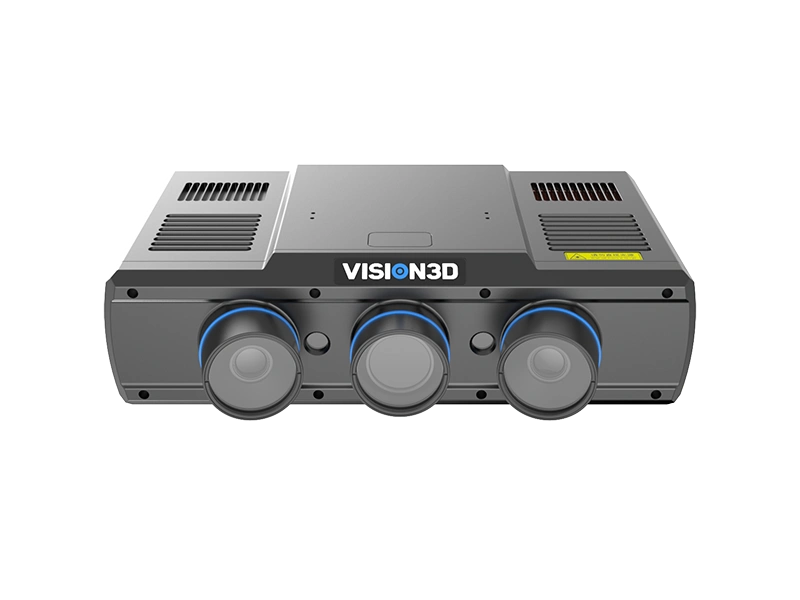
Related Product: PowerScan Blue-Light 3D Scanning System
From Individual Components to Complete Vehicle Verification
As flying vehicle programs mature, inspection requirements extend far beyond individual parts.
Manufacturers must verify dimensional relationships across multiple assembly levels, from individual brackets and structural components to subassemblies, fuselage sections, and complete vehicle structures.
Dimensional accuracy at one stage directly influences performance at the next. Small deviations in mounting interfaces, hole positions, mating surfaces, or structural reference features can accumulate throughout the assembly process and eventually affect overall vehicle quality.
This is why many manufacturers are adopting a hierarchical inspection strategy that combines component-level verification with assembly-level validation.
By maintaining a consistent digital reference system across the entire manufacturing process, engineers can evaluate fit-up conditions before physical assembly occurs, helping reduce adjustment work and improve assembly efficiency.
Virtual assembly analysis supported by 3D measurement data is becoming an increasingly valuable tool for identifying risks before they affect production schedules.
Why Automated 3D Inspection Is Becoming Essential for eVTOL Production
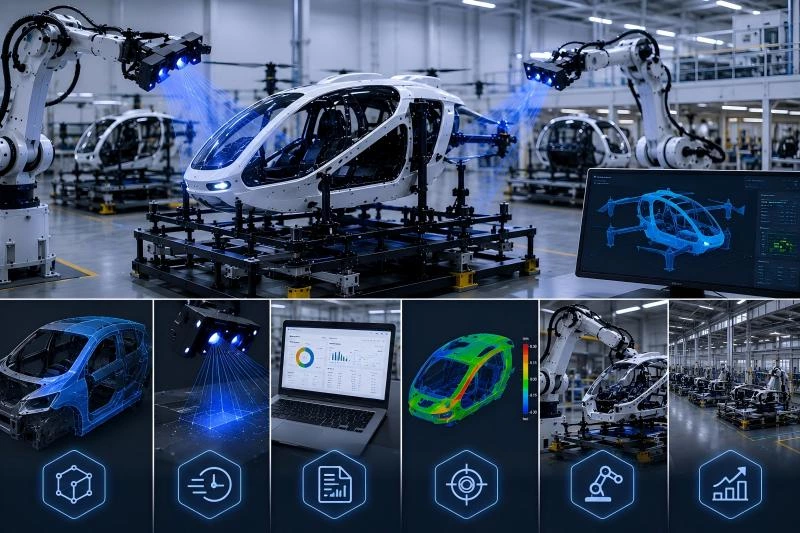
The growing interest in eVTOL manufacturing and advanced air mobility is accelerating investment in digital quality control technologies.
Unlike traditional aerospace programs, many emerging flying vehicle manufacturers are targeting production volumes that more closely resemble automotive manufacturing. This creates a new requirement for inspection systems capable of combining aerospace precision with industrial scalability.
Manufacturers need to inspect more parts, process more data, and generate faster feedback while maintaining strict quality standards.
Automated 3D inspection addresses these challenges by providing:
- Full-surface dimensional verification
- High-speed inspection cycles
- Automated reporting and traceability
- Consistent measurement results
- Production-friendly automation integration
- Scalable inspection capacity for volume production
As eVTOL programs move closer to commercialization, these capabilities are becoming increasingly important for achieving manufacturing readiness and long-term production stability.
The Value of Closed-Loop Quality Data
Inspection data becomes significantly more valuable when it is integrated into a closed-loop quality management system.
Rather than treating measurement results as isolated reports, manufacturers can use digital inspection data to support process optimization, root-cause analysis, and continuous improvement.
Measurement results generated during production can be linked directly to engineering databases, manufacturing execution systems, and quality management platforms. This creates a digital thread that follows components throughout their lifecycle.
Engineers can trace dimensional variation back to specific production events, identify recurring issues, and implement corrective actions based on objective data rather than assumptions.
As production scales, this level of traceability becomes increasingly important for maintaining consistency across multiple manufacturing lines and facilities.
How VISION3D Supports Next-Generation Mobility Manufacturing
As advanced mobility platforms continue to evolve, inspection technologies must evolve alongside them.
VISION3D provides integrated measurement solutions that combine blue-light 3D scanning, robotic automation, photogrammetry, and digital inspection software to support demanding manufacturing environments.
These technologies help manufacturers inspect complex geometries, verify assembly accuracy, manage dimensional quality, and establish scalable digital inspection workflows for future production requirements.
Whether measuring large composite structures, validating assembly interfaces, or supporting automated inspection cells, modern optical metrology systems play a critical role in enabling the transition from prototype development to industrial-scale manufacturing.
Related Solutions:
Conclusion
The future of flying vehicle manufacturing will depend not only on innovative vehicle designs but also on the ability to build them consistently, efficiently, and at scale.
Automated 3D inspection is becoming a foundational technology for achieving this goal. By combining full-field measurement, robotic automation, digital traceability, and process control, manufacturers can improve production quality while preparing for the next generation of advanced mobility systems.
As low-altitude aviation continues to expand, digital inspection technologies will play an increasingly important role in supporting certification readiness, manufacturing efficiency, and long-term product reliability.