Automotive Gap and Flush Inspection: From Quality Verification to Process Control
Vehicle exterior quality is one of the first things customers notice, and it directly affects perceived brand value. In modern automotive manufacturing, ensuring consistent gap and flush between panels is critical for aesthetic quality, wind noise, water sealing, and overall assembly precision.

As new EV models like the Xiaomi SU7 and other industry-leading platforms push higher standards, traditional final-stage inspection methods are no longer sufficient. Manufacturers are shifting toward process-based quality control, where dimensional measurements are taken earlier in the production workflow to reduce defects and rework.
Automated 3D inspection systems now play a central role in monitoring and improving gap and flush quality across body-in-white assemblies, doors, hoods, tailgates, and integrated casting components.
Why Gap and Flush Quality Matters
Maintaining consistent panel spacing (gap) and surface alignment (flush) is essential for:
- Customer-perceived vehicle quality
- Wind noise and water sealing performance
- Door and closure functionality
- Assembly consistency and repeatability
With larger body panels, integrated castings, and complex assemblies in EV platforms, achieving high precision at scale is increasingly challenging.
Limitations of Traditional Gap and Flush Inspection
Manual gauges, feeler tools, and sampling inspection methods have historically been used, but they face several challenges:
- Limited coverage: Only specific points are measured, missing many critical areas.
- Late detection: Dimensional problems are often discovered after assembly, leading to rework.
- Inconsistent results: Operator experience affects measurement reliability.
- Poor traceability: No digital record to analyze trends over multiple vehicles or batches.
The Industry Shift: From Final Audit to Process Control
Leading automotive manufacturers now prioritize inline and pre-assembly inspection using digital methods. Instead of reacting to visible defects, process-based quality control evaluates dimensional deviations early, enabling:
- Early detection of potential gaps or misalignments
- Predictive assembly analysis
- Reduced rework and production interruptions
- Full traceability for quality audits
This trend is accelerating alongside EV adoption and tighter vehicle tolerances.
Challenges in Modern EV Manufacturing
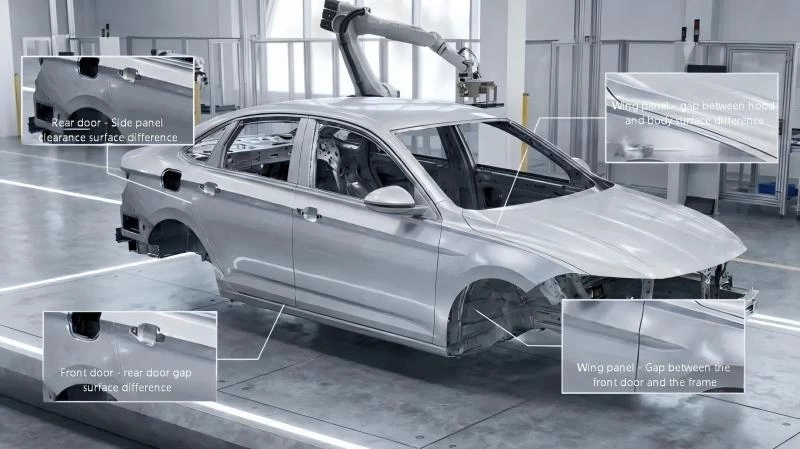
Modern vehicles introduce new challenges for gap and flush inspection:
- Larger body structures: Doors, hoods, and tailgates are bigger and heavier.
- Gigacasting components: Integrated castings reduce part count but increase inspection complexity.
- Higher assembly complexity: More parts and tighter tolerances.
- Stricter audit standards: OEMs require 100% digital traceability and inline reporting.
How Blue-Light 3D Scanning Improves Gap and Flush Measurement
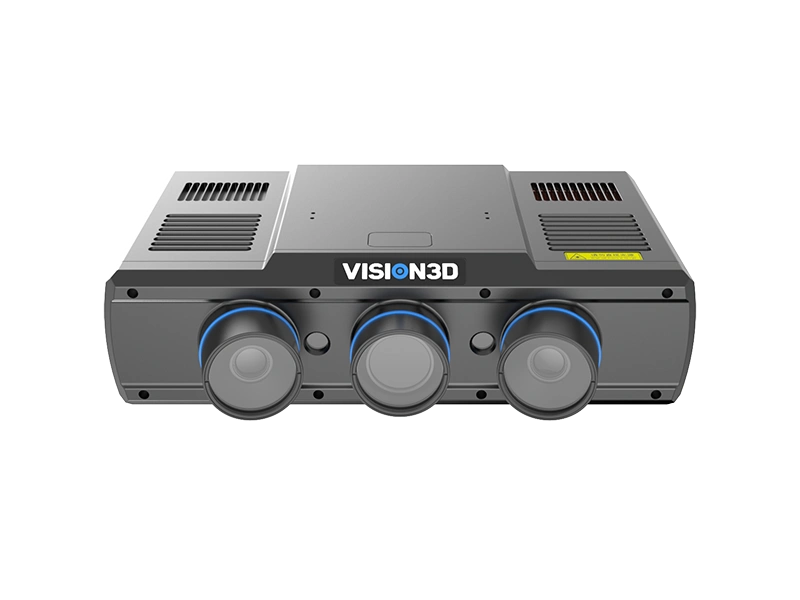
Structured light 3D scanners project a pattern across the surface to capture millions of measurement points, providing full-field dimensional data quickly and accurately. Key advantages include:
- Full-surface coverage rather than limited point sampling
- High-speed acquisition for inline or offline inspection
- Non-contact measurement for delicate surfaces
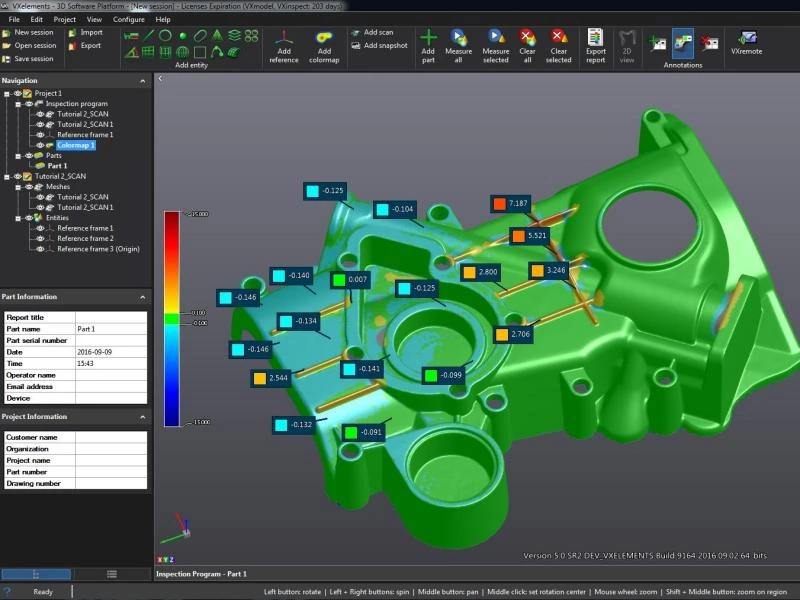
- High-resolution point clouds enabling precise gap and flush analysis
These systems allow manufacturers to detect deviations before final assembly, improving quality while maintaining production efficiency.
Predicting Gap and Flush Issues Before Assembly
By analyzing critical mounting points, reference holes, and flange surfaces, automotive manufacturers can simulate assembly outcomes digitally. This allows:
- Early identification of misaligned panels
- Prediction of door, hood, and tailgate fit issues
- Data-driven decisions to adjust tooling or assembly processes
- Reduced downstream rework and scrap rates
Predictive measurement ensures tighter tolerances and more consistent vehicle fit and finish.
Vision3D Automated Gap and Flush Inspection Solution
Vision3D provides a mature, end-to-end solution for automotive 3D inspection:
- Blue-light optical measurement for full-field point clouds
- Automated inspection workflow for inline and offline applications
- Digital traceability for process audits
- Integration across body-in-white and final assembly
Explore our automotive solutions: https://www.vision3dtech.com/automotive
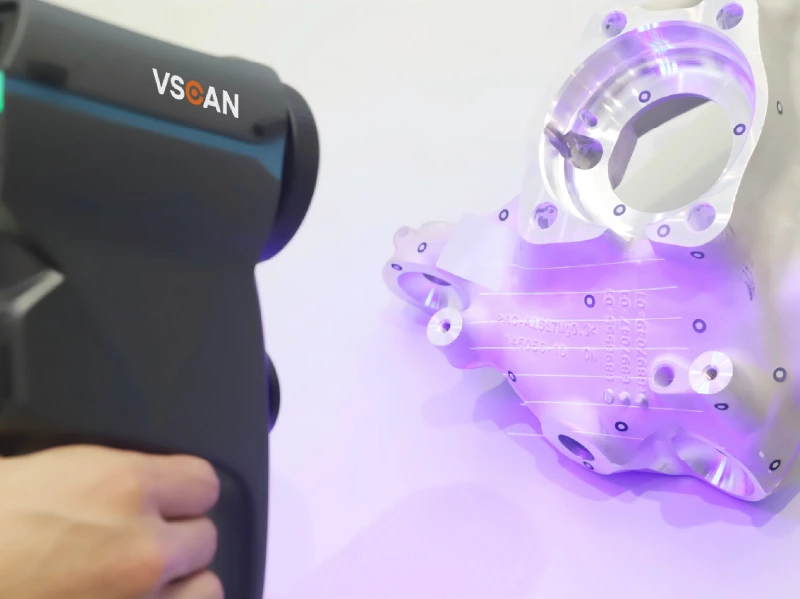
Handheld and Automated Inspection Working Together
For flexibility and spot-checking in complex or hard-to-reach areas, handheld 3D scanners allow engineers to quickly capture detailed measurements.
Our VScan-M Series combines portability with high precision for automotive gap and flush inspection, supporting prototype validation, maintenance checks, and small-batch assemblies: https://www.vision3dtech.com/vscan-m-series
Introduction to the Vision3d Visioninspect Platform
For high-volume and full-body inspection, Vision3D offers Visioninspect, an integrated platform combining:
- Photogrammetry
- Large-scale 3D measurement
- Global coordinate system alignment
- Automated gap and flush analysis
This system enables manufacturers to maintain consistent quality across body-in-white, doors, hoods, tailgates, and battery trays: Visioninspect
The Future of Automotive Quality Inspection
The trend is clear: automotive manufacturing is moving from reactive quality verification toward process-based, predictive inspection.
Key principles include:
- Measure earlier – detect deviations before assembly
- Measure more – full-field, high-density 3D data
- Measure smarter – integrate inline and offline systems with predictive analysis
Automated blue-light 3D scanning solutions, such as those from Vision3D, are helping manufacturers achieve higher consistency, reduced rework, and better fit and finish for modern vehicles.
Conclusion
Automotive gap and flush quality is no longer just a final inspection concern. With increasingly complex EV architectures, higher audit standards, and customer expectations, process-based 3D inspection is essential.
By combining structured light 3D scanners, handheld scanning, and fully integrated automated workflows, Vision3D enables:
- Early detection of assembly deviations
- Predictive analysis of gap and flush issues
- Digital traceability for audits and quality control
- Optimized vehicle fit and finish across multiple production stages
Manufacturers who adopt these technologies gain measurable improvements in efficiency, quality consistency, and brand perception.
FAQ
What is gap and flush measurement in automotive manufacturing?
It measures panel-to-panel spacing (gap) and height differences between connected surfaces (flush) to ensure consistent vehicle appearance and assembly quality.
Why is automated 3D inspection better than traditional methods?
Automated 3D inspection captures full-field data with higher precision, provides predictive analysis, and allows inline quality control rather than only end-of-line verification.
Can handheld 3D scanners be used for gap and flush inspection?
Yes. Handheld scanners, like the VScan-M Series, provide flexible, high-precision measurement in hard-to-reach or prototype areas.
How does Vision3D support process-based quality control?
Through platforms like Visioninspect, manufacturers can integrate BIW, door, hood, tailgate, and battery tray measurements into a unified, predictive quality workflow.
Which vehicle brands can benefit from this technology?
Systems are compatible with multiple platforms, including mainstream automotive brands and modern EV architectures such as Xiaomi SU7, Tesla, and other high-precision models.