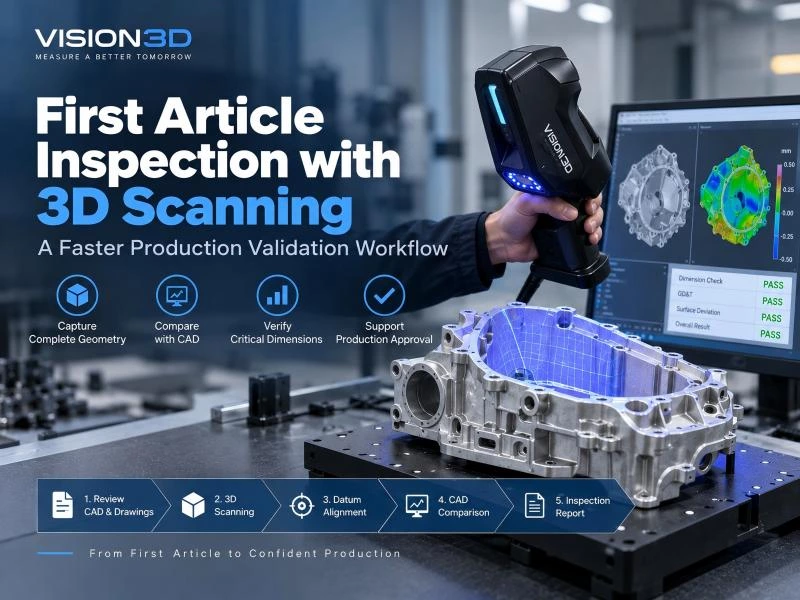
Automotive 3D Scanning Inspection Solution for Car Body and Auto Parts Manufacturing
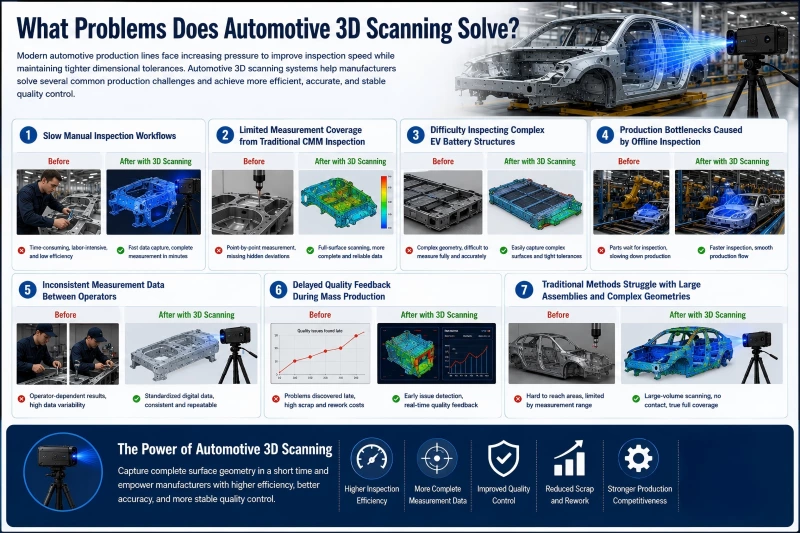
What Problems Does Automotive 3D Scanning Solve?
Modern automotive production lines face increasing pressure to improve inspection speed while maintaining tighter dimensional tolerances. Traditional inspection workflows often struggle with complex EV structures, large body assemblies, and high-volume production requirements.
Automotive 3D scanning systems help manufacturers solve several common production challenges:
- Slow manual inspection workflows
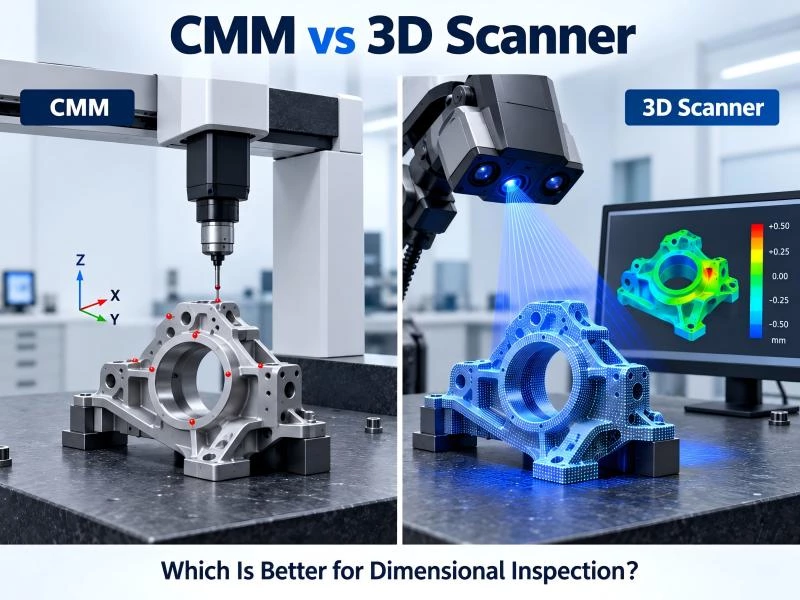
- Limited measurement coverage from traditional CMM inspection
- Difficulty inspecting complex EV battery structures
- Production bottlenecks caused by offline inspection
- Inconsistent measurement data between operators
- Delayed quality feedback during mass production
By capturing complete surface geometry in a short time, optical 3D inspection systems improve dimensional verification efficiency and support more stable manufacturing quality control.
Which 3D Scanning Technology Is Suitable for Automotive Inspection?
Different automotive inspection tasks require different scanning technologies. The right solution depends on part size, inspection speed, automation level, and dimensional tolerance requirements.
| Application | Recommended Technology | Typical Inspection Goal |
|---|---|---|
| BIW inspection | Automated 3D inspection system | Gap, flush, and assembly verification |
| EV battery tray inspection | Blue laser or structured light scanning | Flatness and hole position analysis |
| Large vehicle structures | Optical tracking 3D scanning | Large-scale dimensional inspection |
| Reverse engineering | Handheld 3D scanner | Point cloud acquisition and CAD reconstruction |
| Inline production inspection | Robotic automated scanning system | Real-time quality monitoring |
Many automotive manufacturers combine multiple technologies to balance inspection flexibility, throughput, and dimensional accuracy across different production stages.
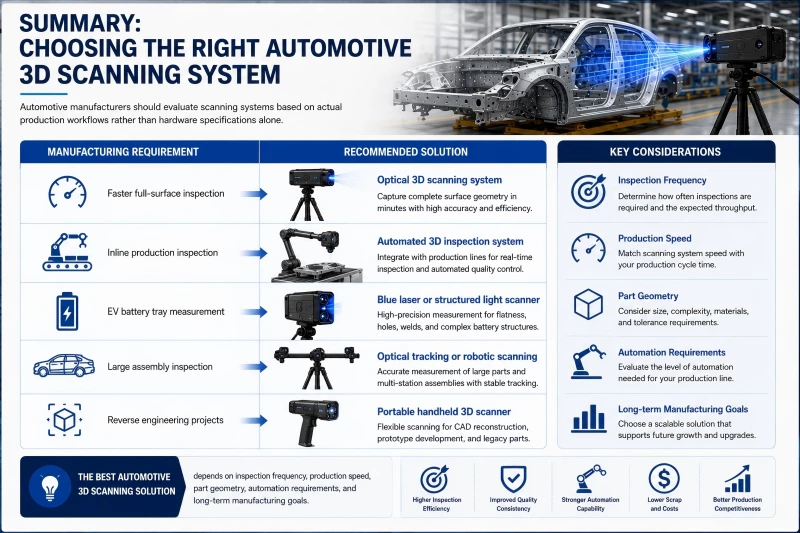
Summary: Choosing the Right Automotive 3D Scanning System
Automotive manufacturers should evaluate scanning systems based on actual production workflows rather than hardware specifications alone.
| Manufacturing Requirement | Recommended Solution |
|---|---|
| Faster full-surface inspection | Optical 3D scanning system |
| Inline production inspection | Automated 3D inspection system |
| EV battery tray measurement | Blue laser or structured light scanner |
| Large assembly inspection | Optical tracking or robotic scanning |
| Reverse engineering projects | Portable handheld 3D scanner |
The best automotive 3D scanning solution depends on inspection frequency, production speed, part geometry, automation requirements, and long-term manufacturing goals.
Vision3D Automotive 3D Scanning Solutions
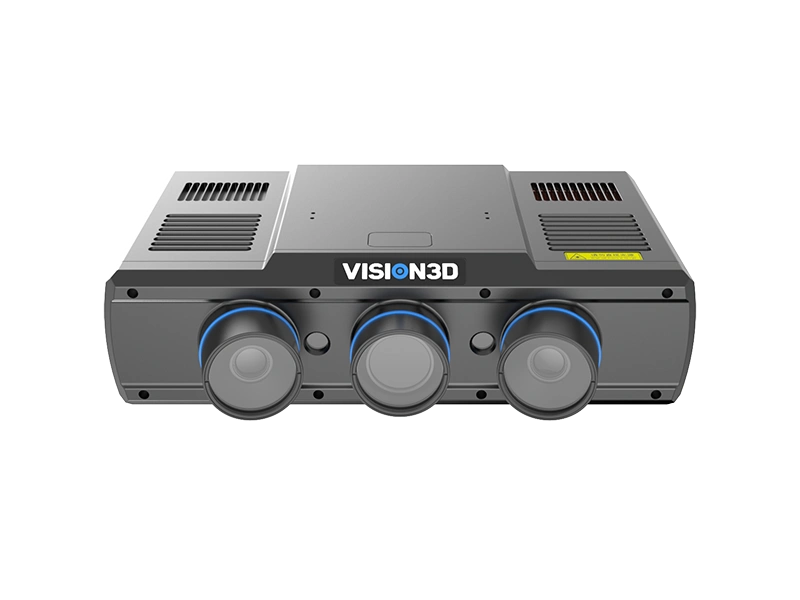
VISION3D provides automotive 3D scanning and automated optical inspection solutions for EV manufacturing, body-in-white inspection, battery tray measurement, stamping inspection, and inline quality control applications.
Our solutions support:
- Automated 3D inspection systems
- Blue laser 3D scanning
- Structured light 3D measurement
- Robotic scanning integration
- Inline dimensional inspection
- CAD comparison and GD&T analysis
Combined with VisionInspect software and automation integration capability, VISION3D helps manufacturers improve inspection efficiency, reduce production bottlenecks, and maintain stable dimensional quality throughout automotive production workflows.